Where LLMs fail
They answer the prompt, not the decision
A stand-alone LLM can generate plausible analysis while leaving the real decision undefined, the criteria unstable and the unresolved tensions invisible.
Meridian is a structured AI-assisted environment — built on my advisory practice — that helps advisors and leadership teams frame decisions, pressure-test assumptions and prepare stronger decision conversations. It is currently available through a limited early-access partner program.
Unlike a general-purpose LLM, Meridian holds a deliberate decision architecture across the full reasoning process: frame, objectives, alternatives, assumptions, trade-offs, evidence gaps and synthesis — keeping each element connected and visible throughout.
Clarify the decision frame, given constraints, objectives, options and unresolved questions.
Pressure-test assumptions, missing evidence, false certainty and trade-offs that are not yet explicit.
Create a concise synthesis that supports better conversations, not automated answers.
They fail because the reasoning around the data is incomplete, political, rushed or poorly structured.
Teams discuss solutions before agreeing on the decision frame, ownership, constraints and what success actually means.
Cost, speed, growth, risk and reputation are often treated separately, while the real value lies in understanding their trade-offs.
The logic, assumptions, discarded options and unresolved uncertainties disappear once the meeting moves on.
A general chatbot can summarise, brainstorm or sound convincing, but it does not know whether the decision frame is complete, which assumptions are doing the work, where trade-offs are unresolved, or who remains accountable for the judgement.
Stand-alone LLMs are useful for language, summaries and idea generation, but they are weak at holding a decision structure over time. Meridian adds the missing layer: a deliberate reasoning architecture that keeps the frame, objectives, alternatives, assumptions, trade-offs, evidence gaps, tensions and synthesis connected.
A stand-alone LLM can generate plausible analysis while leaving the real decision undefined, the criteria unstable and the unresolved tensions invisible.
Meridian anchors the work in context, objectives, options, constraints, assumptions, trade-offs, uncertainty, challenge and synthesis — so the reasoning can be reviewed instead of merely consumed.
Generic copilots often smooth over disagreement, produce a neat recommendation and hide where evidence is thin, incentives conflict or leadership judgement is still required.
Meridian is built to expose weak logic, competing objectives, brittle assumptions, missing evidence and unresolved pressure points before the decision is taken forward.
Chat threads do not naturally preserve why options were discarded, which assumptions changed, what was challenged or what still needs executive attention.
Meridian turns the reasoning journey into a structured synthesis that advisors, leadership teams and boards can revisit, challenge and own.
Meridian reflects my work in decision support, planning, digital products and senior advisory conversations. It is a practical extension of that knowledge and experience: a way to scale structured reasoning, challenge and judgement without losing the human accountability that good decisions require.
Meridian can support structured intake, external challenge, decision review preparation and synthesis after workshops or interviews.
It gives experienced facilitators a repeatable environment to test whether the decision frame is complete and robust.
It creates a shared reference point for the quality of reasoning before a decision is taken to a board, steering committee or investment forum.
Meridian is currently available through selected partner routes. The aim is to protect quality, learn from serious use cases, and make my decision-support experience available in a more structured and scalable form through practitioners who work with real strategic decisions.
For independent advisors, decision-quality practitioners and boutique strategy consultants who want to use Meridian in selected engagements while contributing practical feedback from real decision work.
For advisory firms that want to embed Meridian more structurally into their decision practice or client delivery model, with broader usage across recurring high-stakes engagements.
A future route for corporate strategy, investment, transformation or governance teams that want Meridian as an internal decision-quality environment.
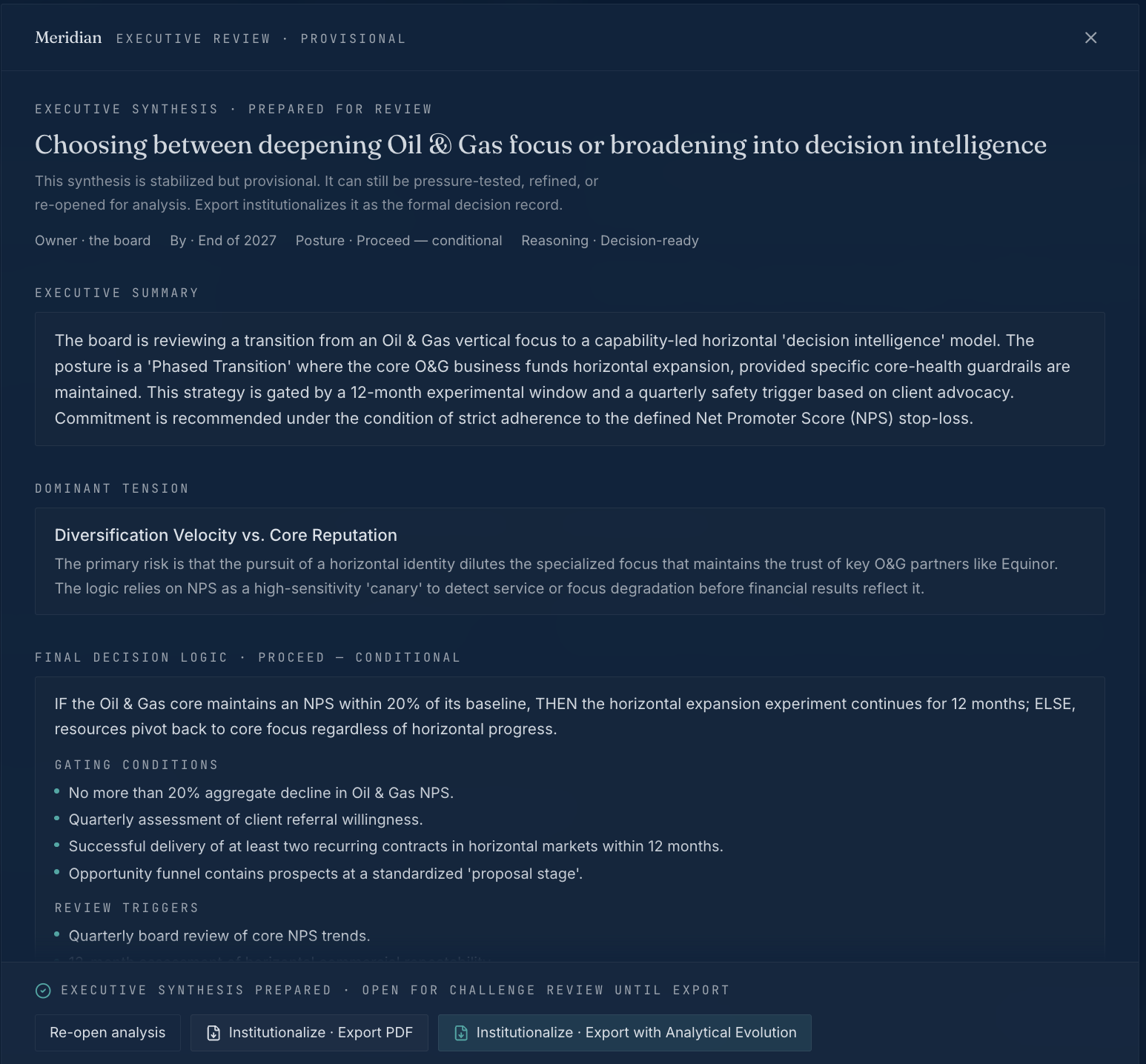
Meridian supports the reasoning journey around a complex decision: first capturing the situation as it is, then structuring challenge around assumptions, alternatives, fragility, tension and synthesis, and finally preparing an executive synthesis that can be reviewed, externally challenged and shared.
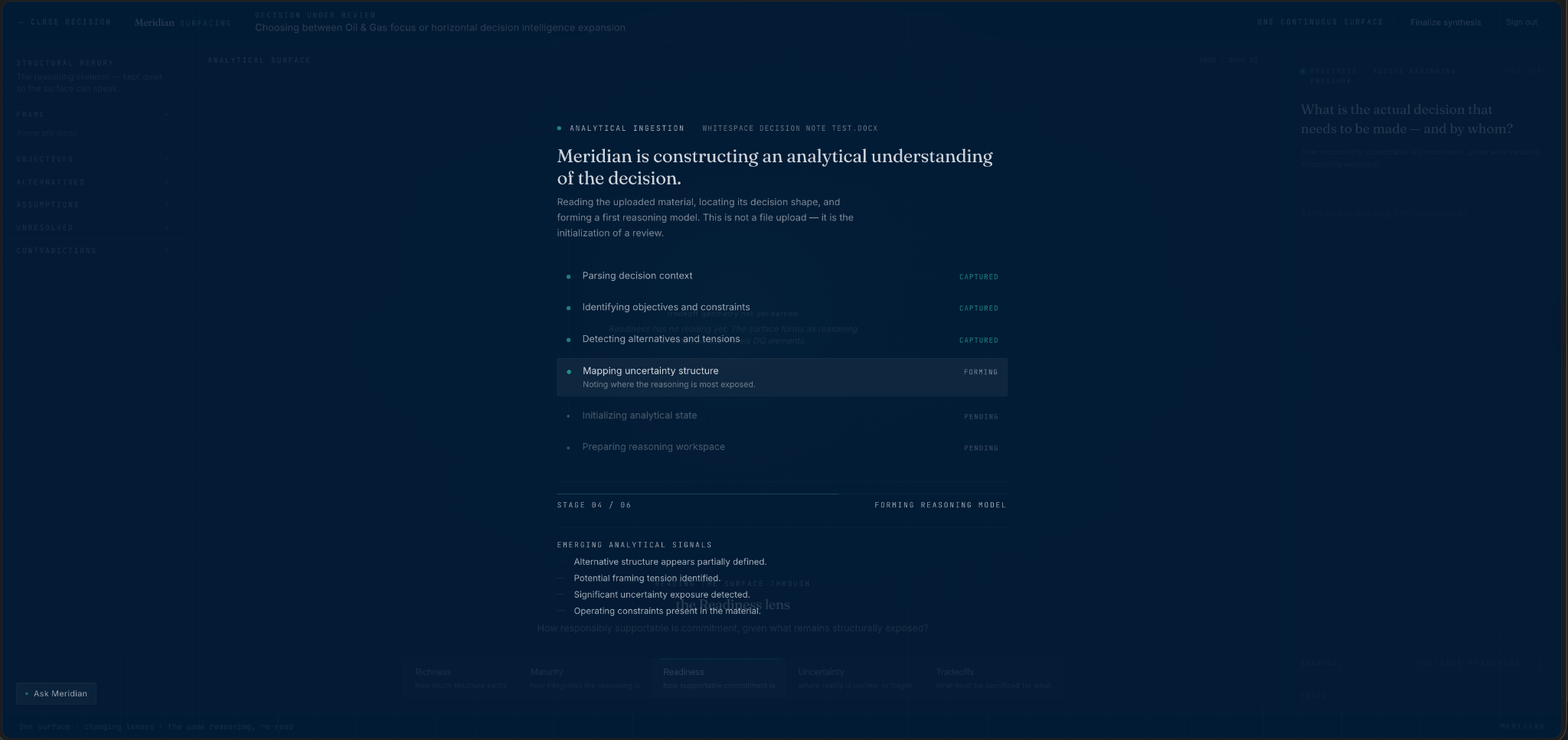
A calm starting point for turning uploaded material into an analytical understanding of the decision — before the system starts reasoning.
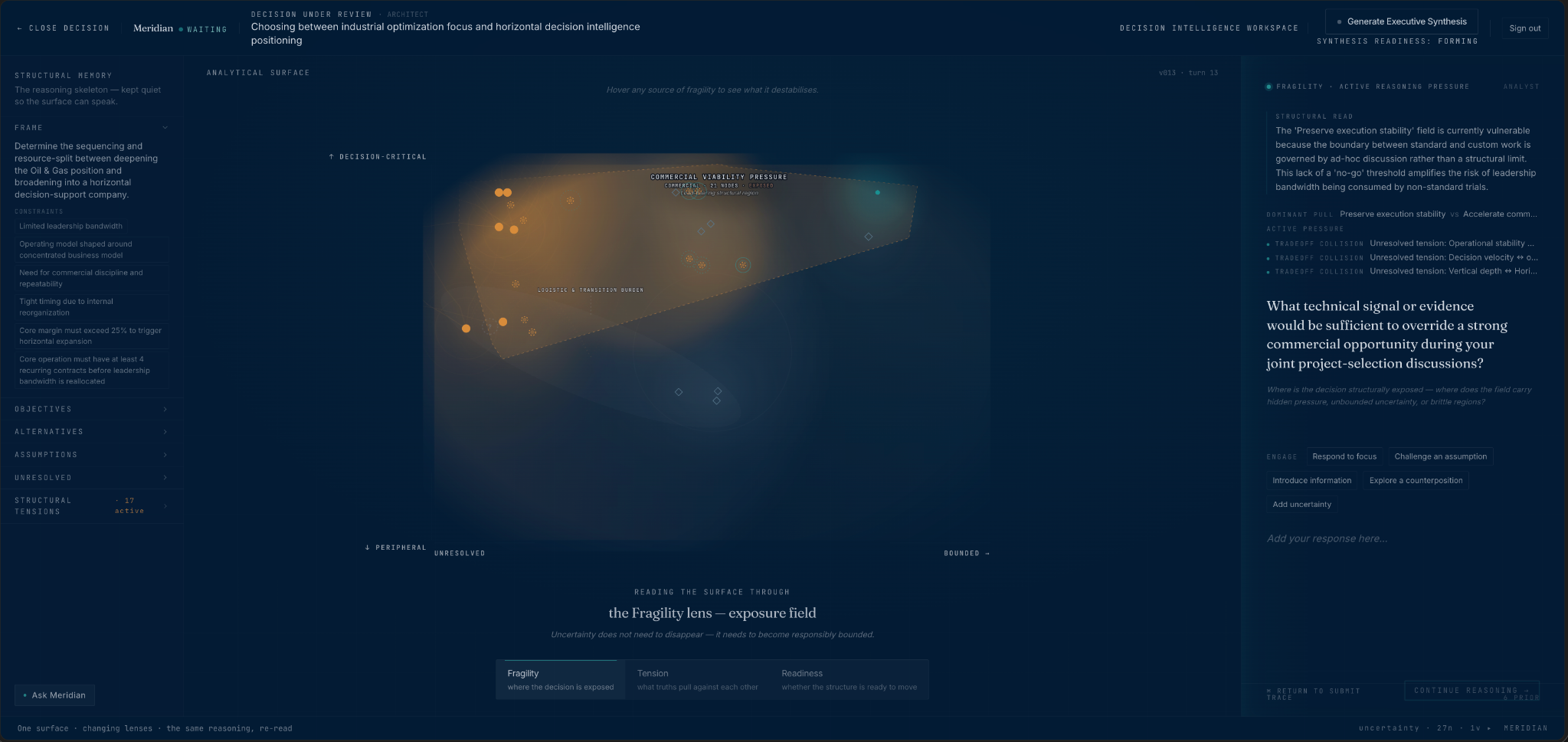
An exposure field that shows where the decision is most vulnerable — helping teams identify the points that need to be bounded before confidence can increase.
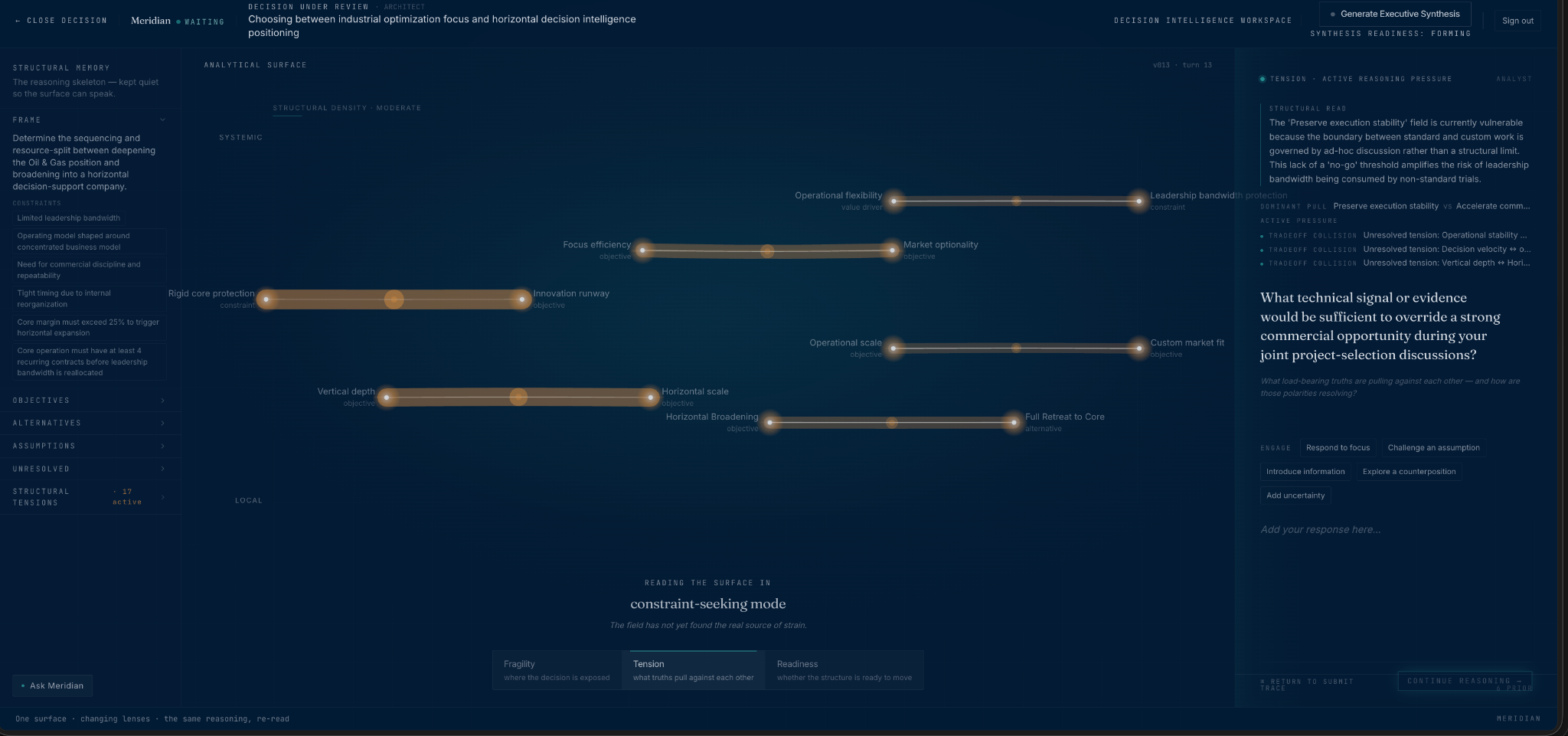
A pressure field that reveals where opposing truths pull against each other, making unresolved tensions explicit without reducing them to a simple trade-off.
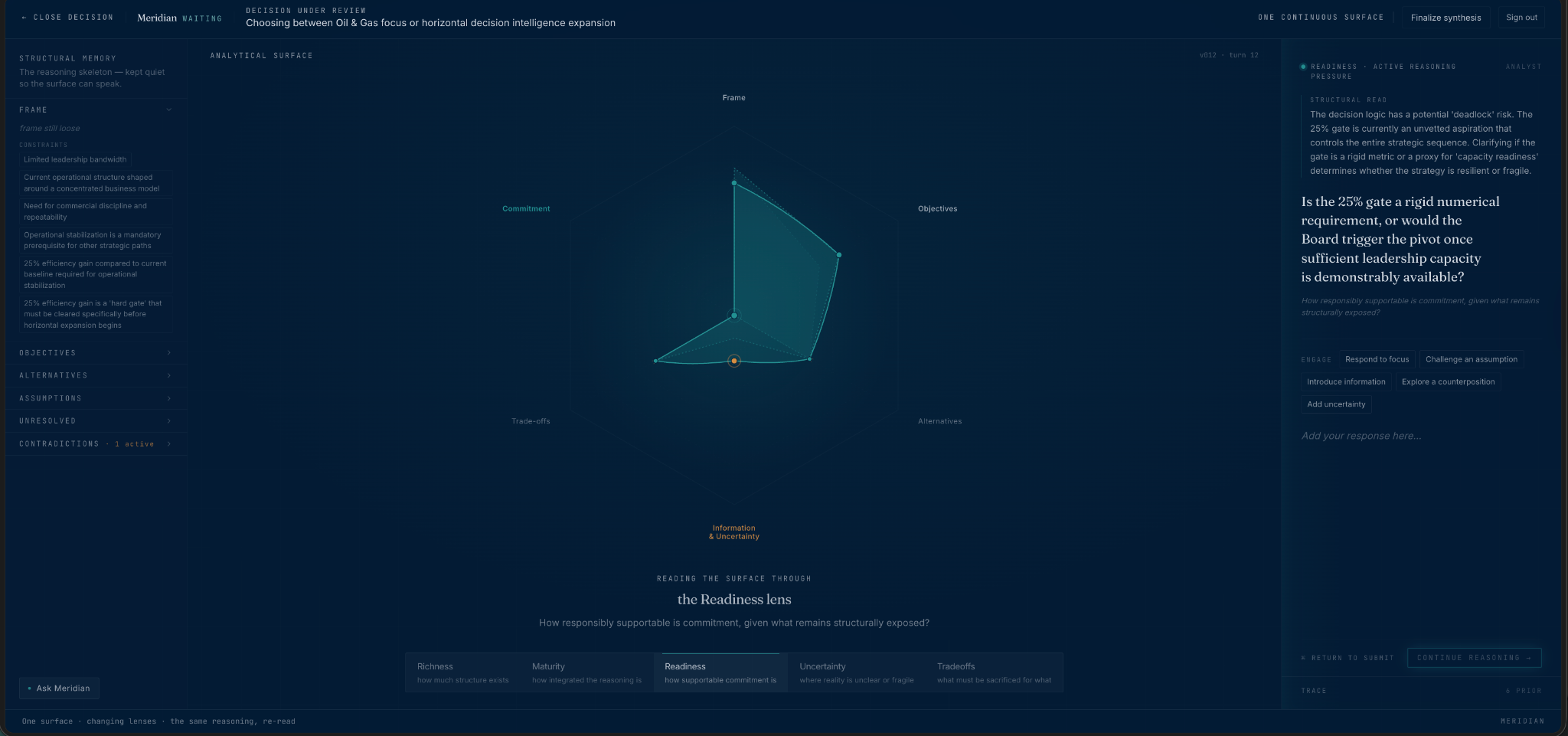
Meridian tests the strength of the decision logic across readiness, uncertainty, tensions and commitment — keeping the challenge tied to the decision-quality structure.
Executive-level output that can be exported, shared and opened up for external challenge before it becomes part of the formal decision record.
Meridian is currently being shaped with a limited group of practitioners and organisations working on complex strategic decisions. The best starting point is a focused conversation about the decisions you support, how you currently structure reasoning, and whether a partner-program route makes sense.
Based in The Netherlands. Engaging internationally.